

Something about Interpol’s music has always felt calibrated for nocturnal listening. There is an abstract edge to it, a sense of something other that makes it perfect for the long dark hours of introspection and melancholy. For twenty five years they have traversed the psychological landscape of loneliness and isolation, finding myriad ways to map the terrain of a culture’s collective midnight anxiety and overwhelm in a way no other band seems capable of emulating.
Much has been written about Interpol’s seminal debut album and the band’s seemingly fully formed emergence from the vibrant early 2000s New York music scene. Turn On The Bright Lights arrived into a world shattered and disoriented by the New York terrorist attack on the World Trade Centre and captured the downcast mood of post 9/11 apprehension and uncertainty, becoming a reference point and touchstone for a kind of desperate nostalgia for something that never really existed.
There is a clear thematic thread connecting this first album to their latest release, This Mirror Weighs a Ton, one that bridges the span of years and scrutinises the state of the world we have blindly stumbled into. If Turn On The Bright Lights was a beacon around which a traumatised society could connect, This Mirror Weighs A Ton wrestles with the inevitable fallout from the political and societal reaction to the events of 9/11 and the seemingly endless wars and upheaval that followed, the excessive surveillance, restricted freedoms and endless violence. The album is a meditation on identity, self reflection, and one’s place in a culture that is growing ever more disconnected and manipulated by seemingly benevolent technology. A culture that is moving exponentially faster than we are capable of keeping pace with.
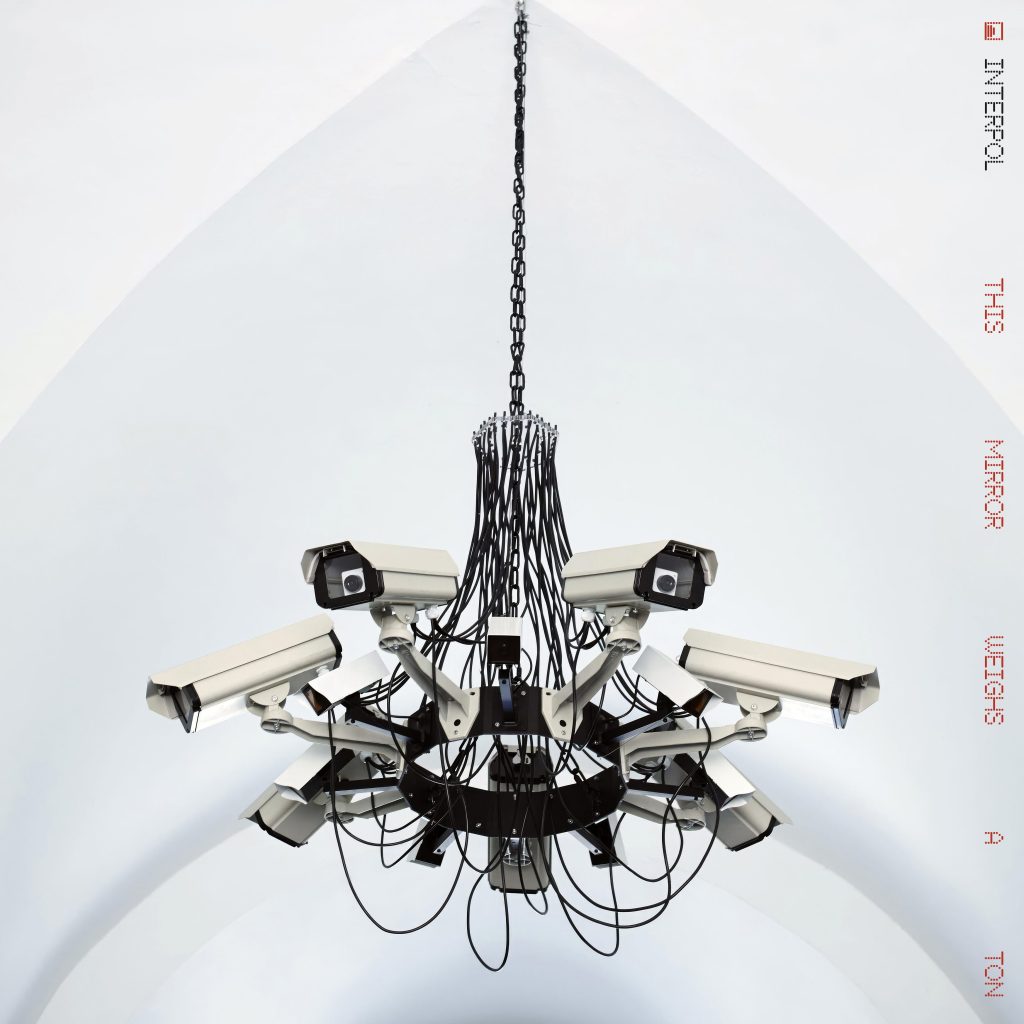
To that end, Addie Wagenknecht’s Asymmetric Love Number 2 is a perfectly apt illustration for the album cover. Resembling a baroque chandelier made up of over a dozen CCTV cameras, the structure is designed to obfuscate the true purpose of the piece by evoking a sense of familiarity, thus subtly encouraging the audience to overlook its more nefarious purpose. It is a clear and direct statement as to the primary concerns of the record and the image hovers over the experience of listening to the album like a persistent and insidious threat.
Opening with the title track, the influence of producer Andrew Wyatt is immediately apparent. He really pushed the band to embrace the more whimsical and experimental aspects of themselves on this record and the results speak for themselves. The ethereal, otherworldly sci-fi tinged sweep of keyboards sound unlike anything Interpol have done before, easing us into the song with a tenderness and warmth before Sam Fogorino’s delicate drums begin to pulse like a fragile heartbeat underneath. Infused with only a sparse scattering of Daniel Kessler’s guitar and layered with Paul Banks’ delicate vocals, the effect is a beautifully hypnotic and dreamy track that might just be one of the best songs they’ve ever made.
It feels like a 3am crisis of the soul, of self reflection and the near physical weight these thoughts can seem to possess. There’s something here about the contrast between the pervasive and ubiquitous external surveillance state we all find ourselves increasingly living under and the dangers present in the act of introspection in the modern world. This is a world in which we are being constantly monitored, constantly judged, where our empathy and weaknesses can be weaponised against us. The mirror weighs a ton because the risk of self-reflection for a society terrified of its own shadow is a heavy burden to bear.
Interpol’s music has always delved into themes of isolation and loneliness but they take it a step further with this album. It explores ideas about what connection means in a world growing further and further apart, separated by politics, beliefs, and technology. How can one truly connect with another when we can’t even be sure the other person is human? The haunting and elegant piano focused Iron City explores this conflict beautifully. A speculative narrative exploring the relationship between humanity and a controlling AI entity, the sense of alienation one can feel even in the familiar, and the effect of the surveillance age upon human connection.

Also having a profound effect on the final shape of this album is the truly collaborative nature of the songwriting and recording process. With the permanent addition of touring musicians Brandon Curtis and Brad Truax to the band the music has become more diverse and dynamic, and Wyatt’s production has helped push the band to into new and unfamiliar territory. The result is a record carefully balanced with a mix of the classic Interpol sound and the more experimental and adventurous ambition of songs like the aforementioned title track, Iron City, So Rides The Reindeer, and the sublime Bird and the Serpent.
See Out Loud and Wings On Fire satisfy cravings for old school Interpol with their driving drums beats, harsh agitated guitars and Banks’ distinctive vocals. Wake Up opens with a frenetic and jittery guitar racing along with a bouncing percussion, with Banks’ softer delivery in the chorus contrasting against the harsher, more frantic pace and the funky sounding backing instrumentation.
The stark piano ballad Enemy is a slow burn with a harsh industrial edge, while album closer Sudden sees us out with a quietly minimalist and sombre ballad stripped of all percussion and delivering a gentle and reflective vocal performance from Banks as he reckons with the realisation that nothing comes suddenly, that the warning signs are always there if you are willing to look for them. The song has a surprisingly resigned sense of hopelessness to it, a lament at the blinkered attitude of a society to a world that is drifting further from our grasp with every passing day. A rebuke to the frequent excuse and self-serving protestation that there’s no way anyone could know how bad things would get.
Despite this contrast in the stylistic makeup of the track-list the album navigates its way through its wonderfully calibrated soundscape perfectly. It is easily the most cohesive album they have put together in years, one energised with a renewed vitality and an eagerness to build something truly remarkable, to embrace change and create in that dangerous territory outside of a zone they were in danger of becoming perhaps a little too comfortable in.
It is rare that a band feels this exciting and fresh over 25 years into their career, willing to push themselves to take risks, to create something genuinely memorable, but that is where Interpol are at this moment in time. This Mirror Weighs A Ton is easily their best album in over two decades – they have taken everything that makes them uniquely them and expanded it outwards into new and endlessly thrilling realms, ones filled with the potential for exciting new discoveries and great promise for the future of this reinvigorated band.